Computers Should Adapt to People
Last time I wrote about why most people outside tech hate AI, and what builders should do about it. This is the personal version of that argument.
I’ve been writing calculator software for nearly 30 years.
What drove me to write PowerOne in the first place was a deep desire to stop adapting to the calculator and have it adapt to me. The calculator allows me to see one number at a time and remember arcane keystrokes to enter and calculate. I wanted to see all my data at once and have entry, calculation, and recall be brain-dead simple. PowerOne works for me, not me working for my calculator.
Once I solved that, I moved on to the next problem. An HP calculator requires you to conform to its concept of time value of money. You mold your problem to its idea of present value, future value, and payment. But industries don’t think that way. Auto financing thinks in trade-in values and APRs. Mortgage brokers think in property values and balloon payments. Financial professionals think in initial and recurring investments. So I made it possible for customers to write their own calculations using the language they’re familiar with.
Still, something was missing.
When I first used a language model, it wasn’t the reasoning that jumped out at me; it was natural language processing. For the first time, I could write something in the language I’m familiar with and have the computer translate and understand it.
To quote the same passage from the same article again, I think Nilay Patel’s piece in The Verge said it best. He’s writing about why most people outside tech hate AI, and he says this (emphasis his):
I’ve reviewed a lot of tech products over the past decade and a half, and all I can tell you is that it is a failure when you ask people to adapt to computers. Computers should adapt to people. Asking people to make themselves more legible to software — to turn themselves into a database — is a doomed idea.
Computers should adapt to people. That’s been the through-line for me from the beginning. Visicalc, then Lotus 1-2-3, then Excel made accountants’ jobs easier because they could change one number and see the impact, instead of starting from scratch. WordPerfect, then Word, made it easy to move paragraphs around after writing. Photoshop made it easy to fix the blemishes. The best software has always met people partway, asking them to learn less and rewarding them more for what they do learn.
That’s the lens through which I see language models. Not as reasoning engines but as translation layers. For the first time, the overhead of calculation can disappear. You talk in your language, the computer figures out the math.
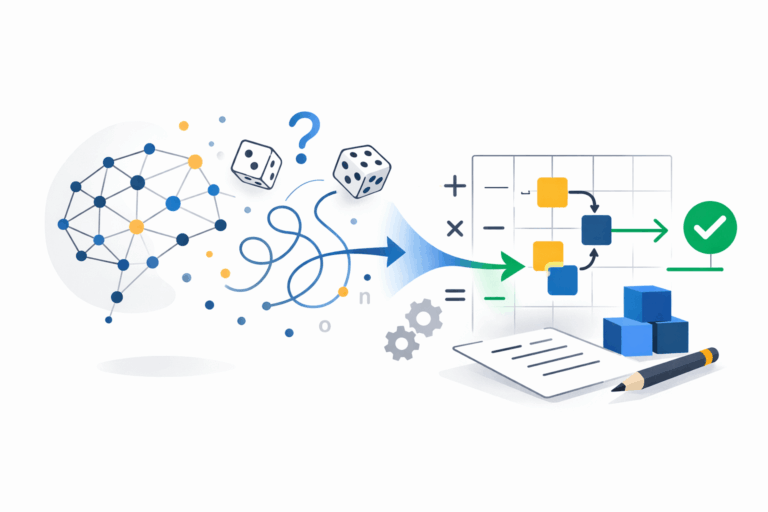
Except LLMs are unreliable at math, especially when you need auditability, governance, and guaranteed-correct results. Which is exactly what regulated and high-stakes work requires.
So for the past two years, I’ve been working on what natural language means for performing mathematics. How does it change how we interact with the calculator? How does it change the way work gets done? And (most importantly for the regulated and high-stakes side) how do we make language models do math correctly, with the audit trails and governed computation those situations demand?
We’re close to launching TrueMath. Sign up here if you’d like to be one of the first to try it.
After 30 years of this, the goal hasn’t changed: the calculator should work for you not the other way around.
Reach out: elia.freedman@truemath.ai
Learn more: truemath.ai
Sign up for early access: https://app.truemath.ai/signup
Discover more from TrueMath
Subscribe to get the latest posts sent to your email.